The question comes up in almost every initial conversation when someone wants to build a SaaS:
"Laravel or Node.js?"
The honest answer is: it depends. But there are clear criteria for deciding, and at Nebula we use both depending on the project. Here we explain when we choose one over the other and why.
What do we mean when we talk about SaaS?
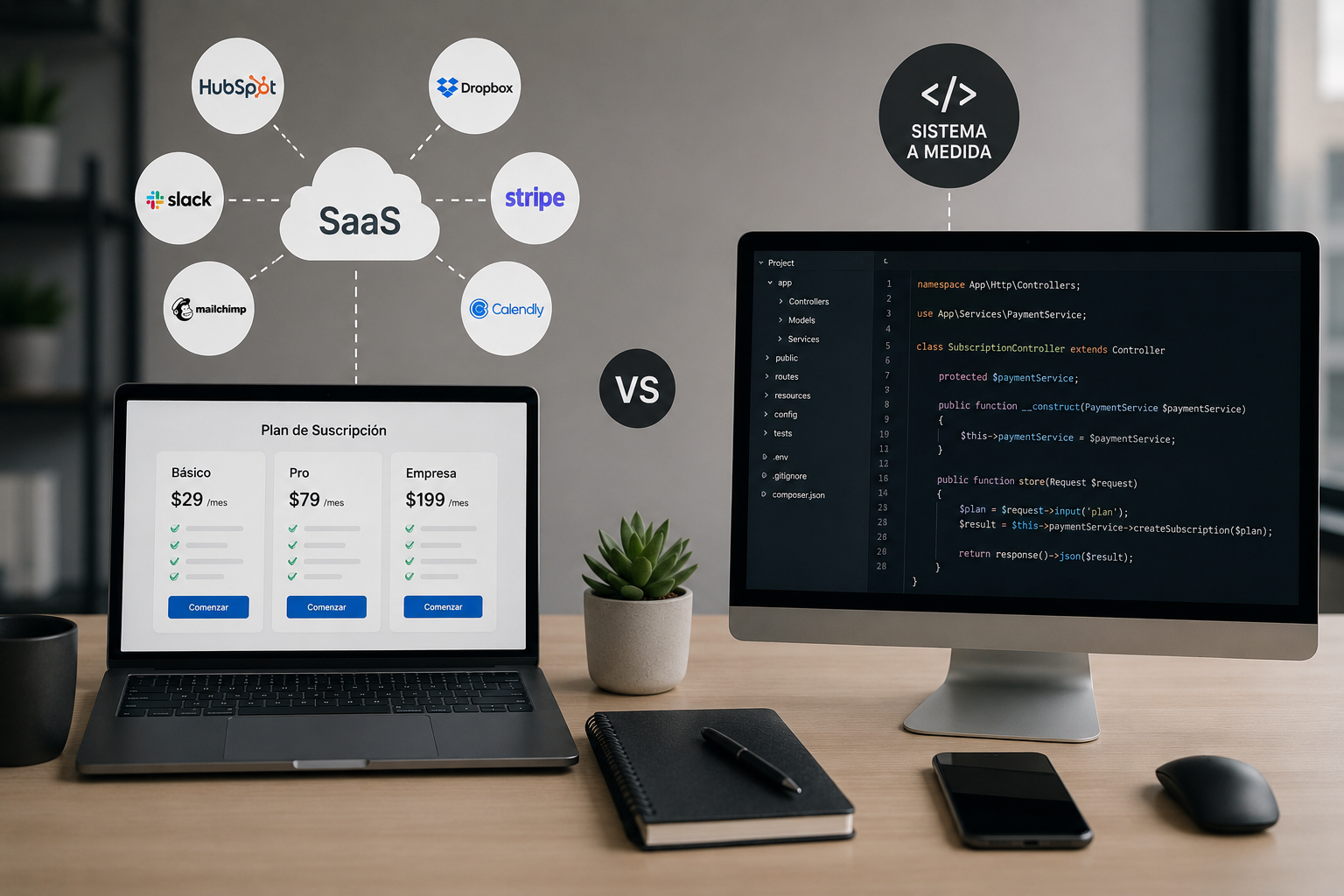
A SaaS has characteristics that distinguish it from a regular website:
The backend choice directly affects how quickly each of these pieces can be built - and how easy it is to maintain afterward.
Laravel: when it's the right choice
Laravel is a PHP framework with more than a decade of maturity. Its ecosystem solves out-of-the-box problems that in other stacks require additional libraries, research and architecture decisions that consume time.
Choose Laravel when:
Real Nebula cases where we chose Laravel: MyOfficeTaxes (digital signatures and tax automation), Epsilon Soft (reading platform with 50,000 daily users), Jobu (recruitment platform with matching algorithm), Blucenter (inventory system and dashboard).
Laravel has an accessible learning curve, excellent documentation and an ORM that makes working with relational databases natural. For complex business logic, it's hard to beat in terms of development speed.
Node.js: when it makes sense
Node.js shines in specific scenarios that leverage its asynchronous, event-driven nature.
Choose Node.js when:
When Node.js can be a trap: when the team doesn't have solid experience in asynchronous error handling, when the business logic is complex and relational, or when development time is critical and there's no time to choose and integrate libraries for each feature that Laravel already includes out of the box.
The direct comparison
| Criterion | Laravel | Node.js |
|---|---|---|
| Initial development speed | High (batteries included) | Medium (you choose your tools) |
| Real-time performance | Good (with websockets) | Excellent |
| SaaS ecosystem | Very mature | Mature but fragmented |
| Learning curve | Low-medium | Medium |
| Multi-tenancy | Dedicated packages | Manual or with libraries |
| ORM / Database | Eloquent (very good) | Prisma / TypeORM (good) |
| Consistency in large projects | High (strong conventions) | Depends on the team |
The most underestimated factor: technical debt
In SaaS projects that grow, technical debt appears when the team made hasty architecture decisions because there was no framework guiding them.
Laravel has strong conventions. That can feel restrictive at first, but in 12+ month projects with multiple developers, those conventions are what keeps the code readable and maintainable.
Node.js gives more freedom. But freedom without discipline generates projects where each module is written differently because each developer made their own decisions.
What really matters
The stack is never the problem in itself. The problem is not having clarity about what the system needs, building without a thought-out architecture, or switching technologies mid-project.
In projects where time-to-launch matters and business logic is central, Laravel lets us deliver faster with less uncertainty. In projects where real-time performance is critical or the team already lives in JavaScript, Node.js is the natural choice.
Most of the SaaS products we build fall into the first group.
Questions about which stack to use in your project?
Before starting to build, it's worth having a technical conversation that clarifies what your system actually needs. That avoids months of work in the wrong direction - or worse, a system that works but no one on the team can maintain.
Schedule a free diagnostic. No commitment and no sales pitch.
Share

Written by
Santiago Bugnón
CTO @ Nebula Solutions
We build this at Nebula