Most apps that fail don't fail due to technical issues. They fail because no one wanted them badly enough to pay for them.
Validation is the process of discovering that before investing months and thousands of dollars in development.
Why most people skip this step
There's a huge gap between "I think it's a good idea" and "there are people willing to pay for this." The problem is that the excitement of building leads many founders to skip validation and go straight to development.
The result: apps launched with features no one asked for, for users who never show up.
The base principle: the sooner you fail, the less you lose
Validation is not a bureaucratic formality. It's a process that minimizes the risk of investing in the wrong direction. Validating well before development can save you USD 30,000 and 6 months of work.
The five steps to validate before building
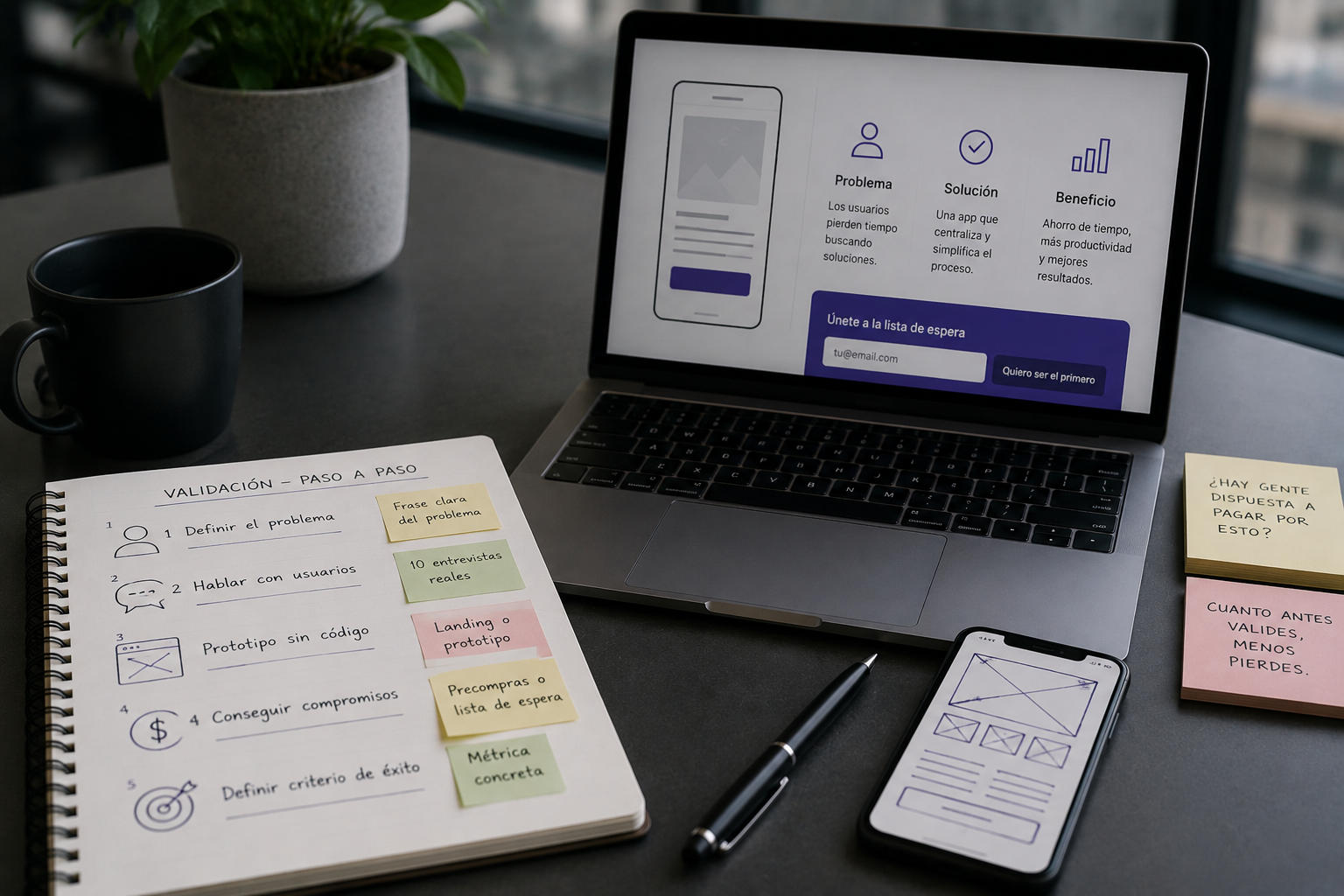
1. Define the problem, not the solution
Before thinking about features, write in one sentence what problem you solve. "I help [who] to [do what] when [in what context]."
If you can't complete that sentence clearly, you're not ready to validate yet.
2. Talk to 10 people in your target segment
Don't do surveys. Have conversations. Ask about the problem, not your solution. Listen to whether what you describe resonates with them, whether they're already solving it somehow, and how important it is to them.
Ten honest conversations are worth more than a hundred form responses.
3. Build a no-code prototype
Figma, a presentation, a Loom video showing the flow, or directly a landing page with a "sign me up" button. The goal is to see if people react to the concept before it exists.
A landing page with a waitlist form that gets 200 organic subscribers in two weeks tells you more than any focus group.
4. Get pre-orders or real commitments
"I think it's interesting" doesn't count. What counts:
If no one is willing to commit, the problem doesn't hurt enough or your solution isn't the right one.
5. Define success criteria before you start
"If in 30 days I get 20 pre-orders of USD 50, I'll start development." Without that number, you'll always find a reason to keep waiting or to convince yourself that "it's already validated."
Signs that it's still not validated
What to do when it is validated
With real validation (commitment to pay, not just interest), the next step is the MVP. Not the full product: the minimum necessary for those who already said yes to be able to use what you promised.
At Nebula we help founders define that scope and build it thoughtfully. If you already have validation and are ready for the next step, let's talk.
Share

Written by
Ana Olivia Todesco
CEO @ Nebula Solutions