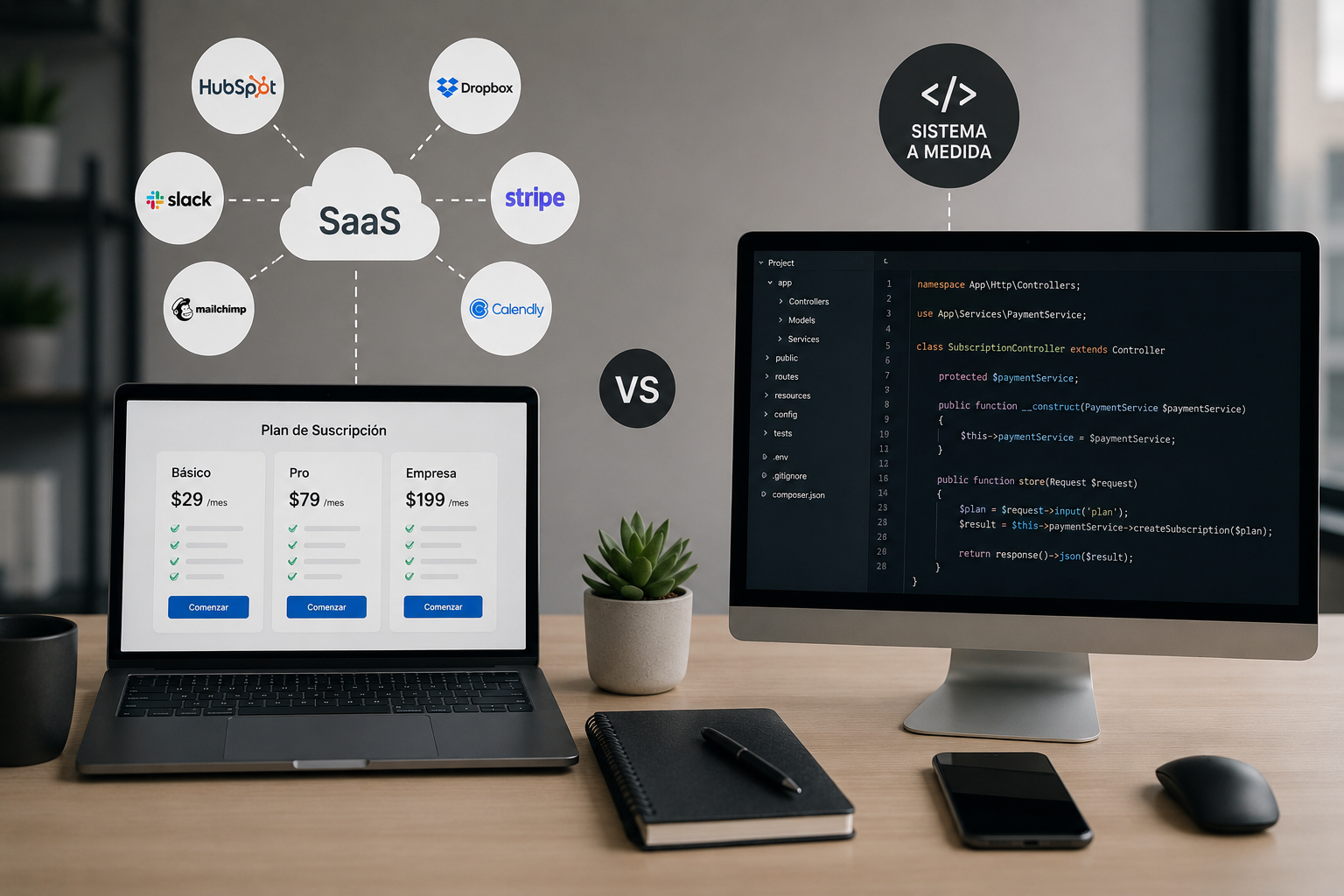
One of the most common questions we receive is: "Should I use an existing SaaS or build my own system?"
The honest answer is that it depends on four concrete variables, not ideological preferences. Here we break them down.
The real difference between SaaS and custom software
SaaS (Software as a Service)
It's a pre-built product you pay to use. HubSpot, Notion, Shopify, Calendly - these are all SaaS. Someone invested in building them for many users with similar needs. You pay a subscription and get access the next day.
Custom software
It's software built specifically for your business, with your logic, your rules and your workflows. It doesn't exist until you commission it. The upfront cost is higher, but there are no customization limits and no third-party dependencies.
When to use an existing SaaS
1. Your need is standard
If you need to manage support tickets, send newsletters or process simple payments, there are mature SaaS solutions for that. Reinventing the wheel makes no sense.
2. You're in the validation stage
If you still don't know whether your business model works, don't invest in your own infrastructure. Set up the process with existing tools, validate with real customers, then build.
3. The volume doesn't justify the cost
An internal management system for a team of 5 people probably doesn't justify custom development if Notion, Airtable or Trello solve the problem with configuration alone.
When to build custom
1. Your business logic doesn't fit any mold
If your operation has specific rules that generic SaaS tools don't support, or if you end up using ten tools that never connect well with each other, it's time.
2. Customization is your competitive advantage
If what you sell depends on a differentiated experience that no SaaS can give you, building is part of the product.
3. You want to be the SaaS
If your business model is offering software to others, you clearly need to build your own. You can't resell Shopify under your brand and call it a product.
4. SaaS costs scale poorly
Many SaaS tools charge per user or per transaction volume. If after 12 months you're paying USD 3,000 a month in tools, a proprietary system can pay itself off in 18 months.
The "I'll wire it all together with Zapier" trap
Connecting five tools with Zapier works for validation. But when you have 200 clients, 500 daily transactions and three people maintaining automations, the hidden cost (time + errors + outages) exceeds that of a custom system.
The most ignored factor: third-party dependency
With SaaS, someone else makes the rules. If tomorrow they change their pricing, change an API or decide to shut down the product, your operation depends on that decision. With custom software, you own the code and the infrastructure.
Our practical recommendation
| Situation | Recommendation |
|---|---|
| Validating idea, no revenue | Existing SaaS |
| Growing operation, standard logic | Existing SaaS (well configured) |
| Complex logic, digital competitive advantage | Custom software |
| SaaS costs exceed USD 2,000/month | Evaluate building |
| You want to sell software as a product | Build |
If you're not sure which path makes more sense for your situation, schedule a call. We review your case at no cost and tell you what makes technical and commercial sense.
Share

Written by
Ana Olivia Todesco
CEO @ Nebula Solutions