You have a digital product idea. Or maybe you already have an MVP running on Bubble, Webflow, or Framer with your first paying customers. At some point the inevitable question arrives: should I keep building with no-code or is it time to make the leap to professional development?
At Nebula Solutions we work every day with founders who made exactly that journey. That's why we want to give you an honest answer, without bias: no-code is a powerful tool at the right moment. But it also has real limits that, if you don't identify them in time, can become the biggest brake on your business.
What Is No-Code?
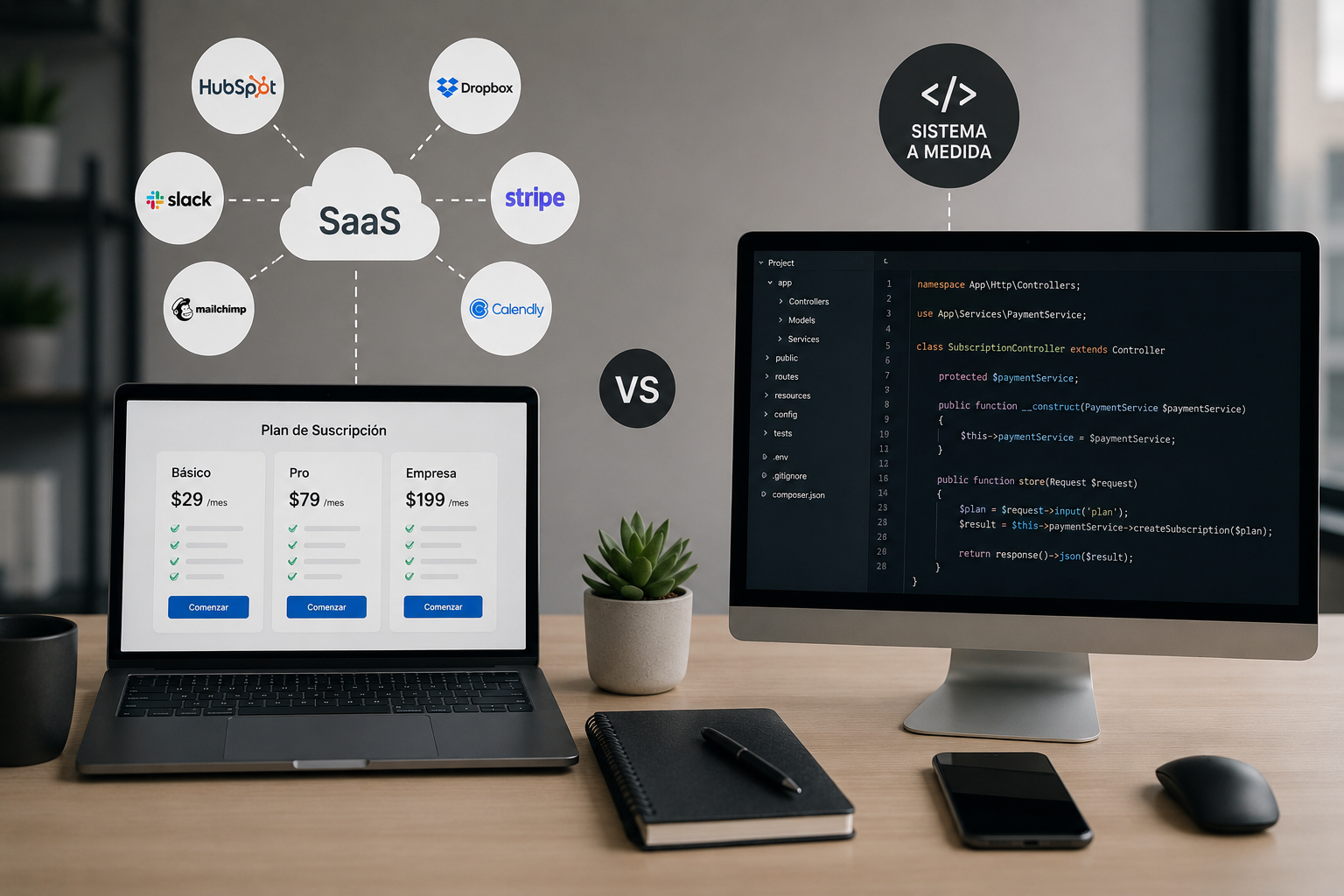
No-code is a set of platforms and tools that allow you to build digital products - websites, apps, automations - without writing code. Tools like Bubble, Webflow, Framer, WordPress or Glide have democratized software creation by eliminating the technical barrier to entry.
Anyone with an idea and time can launch a functional product in days or weeks. And that, in the early stages of a startup, is a superpower. No-code allows you to validate business hypotheses with minimal investment before committing significant resources to development.
What Is Professional Development?
Professional development consists of building software by writing real code, using languages and frameworks designed for production at scale. At Nebula Solutions we work primarily with Laravel + Inertia + React for robust web applications, and with Python for everything related to artificial intelligence, complex automations, and data APIs.
Unlike no-code, professional development has no customization limits. The product you imagine is the product that gets built - without depending on what a third-party platform allows or not.
Advantages of No-Code
Launch Speed
The most powerful advantage. An MVP in Bubble or Webflow can be operational in days. No need to configure infrastructure, design an architecture, or write a single line of code. To validate whether there's real market demand, nothing beats the speed of no-code.
Low Initial Cost
Hiring a professional development team involves a significant investment. No-code dramatically reduces that initial cost, freeing up resources that in the early stages are more valuable for marketing, acquisition, or product iteration.
Technical Independence
If you're a non-technical founder, no-code allows you to be self-sufficient. You can build, iterate and adjust your product without depending on a developer for every small change.
Fast Iteration
Does your user ask for a change in the onboarding flow? Need to add a new field? In no-code that can take minutes. The agility to iterate based on feedback is a real advantage that shouldn't be underestimated.
Disadvantages of No-Code
Customization Ceiling
No-code platforms offer a predefined set of functionalities. While your product fits within those limits, everything is fine. But the moment you need something specific - your own recommendation engine, complex business logic, custom integrations - you hit a wall. You can't build what the platform doesn't allow.
Performance Problems at Scale
No-code platforms generate generic code, not optimized for your use case. With few users this is invisible. With real growth - thousands of simultaneous sessions, heavy database queries, real-time processes - performance degrades and you have no control over the root cause.
Vendor Lock-in: The Risk That Hurts Most Later
Your product lives on a third party's infrastructure. If that platform raises prices, changes its business model, or simply shuts down, your business is exposed. You don't own your technology, you're renting it.
Atención
Real vendor lock-in: if the platform you use disappears or radically changes its terms, migrating can be as costly as having built from scratch. Evaluate this before committing your business long-term.
Invisible Technical Debt
Every plugin added, every chained automation, every workaround implemented is accumulated technical debt. Over time, the product becomes fragile and practically impossible to scale without breaking something.
Red Flag for Investors
When an investor does technical due diligence and discovers that the backend lives in Bubble or that there's no real code ownership, the conversation changes. They're not buying a tech company - they're buying a subscription to a third-party platform.
Advantages of Professional Development
Full Control Over the Product
With professional development, every technical decision is yours. You can optimize performance, design the architecture your business model needs, and build exactly the features your customers request. At Nebula we use Laravel with Inertia and React to build applications that are robust on the backend and rich on the frontend, without the compromises no-code imposes.
Real Scalability
A well-designed architecture grows with you. You can optimize database queries, implement smart caching, separate services when volume requires it, and guarantee consistent response times regardless of load.
AI and Advanced Logic Capabilities
If your product needs artificial intelligence - personalized recommendations, natural language processing, predictive models - development with Python opens up a universe of possibilities that no-code can't even touch. Integrations with custom models, data pipelines, or machine learning APIs require real, well-structured, maintainable code.
Enterprise Security and Compliance
For regulated markets or enterprise clients, security standards are non-negotiable. SOC2, GDPR, access auditing, granular permission management - all of this requires infrastructure control that no no-code platform can guarantee.
Real Ownership of the Technology Asset
When you build with your own code, the software is yours. No vendor lock-in, no third-party dependency. That turns your product into a real asset - valuable, sellable, and scalable without artificial limits.
Disadvantages of Professional Development
Higher Initial Investment
Building well from the start has a higher cost than setting up a no-code MVP. It requires an experienced team, planning time, and an architecture designed to last.
Nota
Tip: if you're still validating whether there's real demand for your idea, the cost of professional development probably isn't justified yet. Use no-code to validate, then scale with code.
Dependency on the Technical Team
Without a trusted development team, maintaining or evolving the product requires hiring or outsourcing. That's why choosing your technical partner wisely is as important as the technology itself.
Initial Setup Time
Setting up a solid architecture takes longer than launching a Bubble. Infrastructure, environments, deployment pipelines - it all adds up. For someone who needs to validate a hypothesis in two weeks, professional development may not be the right starting point.
When to Use Each?
The answer isn't a religion. It's a strategic decision that depends on the stage of your company.
Use no-code when...
Make the leap to professional development when...
Importante
The most costly mistake: continuing to build on no-code once you already have traction and paying customers. Every week that passes, technical debt grows and the cost of migrating increases. Identifying the right moment for the leap is part of your company strategy, not just a technical decision.
Conclusion
No-code and professional development aren't enemies. They're tools designed for different moments in a product's lifecycle. The mistake isn't in using one or the other - it's in using the wrong one at the wrong time.
Start with no-code if you're validating. But when your product has already proven it has market fit and starts hitting the platform's limits, staying there has a growing cost that many founders underestimate until it's too late.
The good news: migration doesn't have to be traumatic. With the right planning, it can be done incrementally, without interrupting operations and preserving everything that already works.
At Nebula Solutions we help non-technical founders make this leap with clarity and confidence. We build custom platforms - SaaS, marketplaces, internal tools - using Laravel + Inertia + React for robust web applications and Python for everything involving artificial intelligence and data processing.
Schedule a free call with our team and we'll analyze your situation without commitment.
Share

Written by
Ana Olivia Todesco
CEO @ Nebula Solutions
We build this at Nebula