"I need to build a marketplace."
That phrase can mean very different things. A marketplace where people buy and sell second-hand items is one architecture. A marketplace where companies hire industrial service providers is a completely different one.
Confusing them at the start of a project is one of the most expensive mistakes in software. Here we explain the differences that matter - not the superficial ones, but the ones that affect how the system is built from the ground up.
What differentiates a B2B marketplace from a B2C one?
It's not just the audience. It's the business model, transaction flows, legal requirements and, consequently, the system architecture.
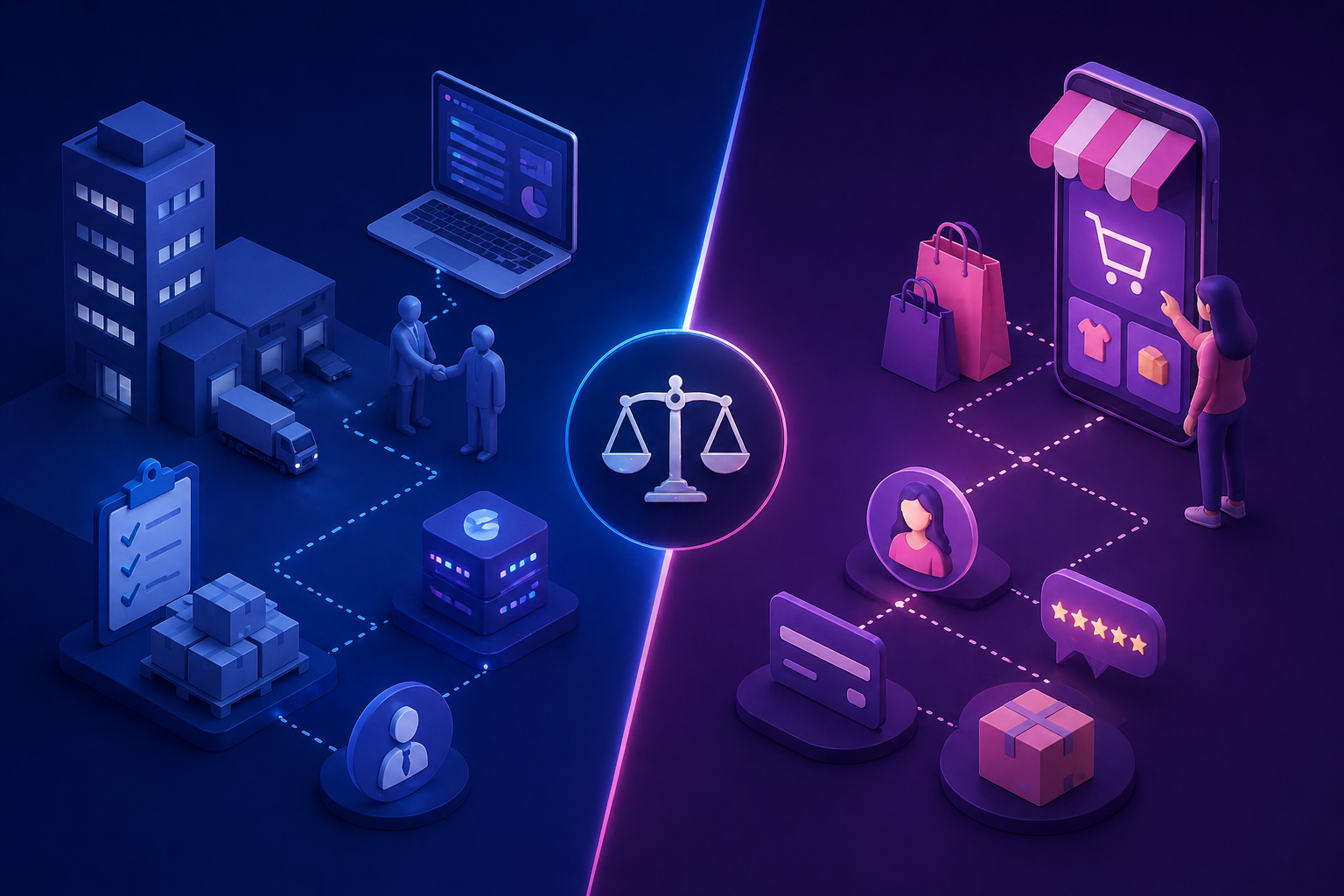
B2C Marketplace (Business to Consumer)
B2B Marketplace (Business to Business)
The architectural differences that matter most
User and role system
B2C: sellers and buyers with relatively simple profiles. A user can be a seller, a buyer or both.
B2B: organizations with multiple internal users and differentiated roles. The "buyer" can be a company with a procurement team that generates the request, a manager who approves the spend and an ERP system that receives the final invoice. The "seller" can have support, sales, billing and logistics as separate users with different access levels.
This directly impacts the authentication model, the permission system and the database structure. In B2B, the base entity is not the "user" - it's the "organization," and users belong to organizations.
Search engine and matching
B2C: keyword search, price and category filters. The user roughly knows what they want and searches for it.
B2B: search with complex criteria: supplier certifications, production capacity, geographic zone, compliance history, minimum order volume. Sometimes the matching is done by a human marketplace operator, not an algorithm.
Transaction management
B2C: the flow is relatively simple - cart, payment, confirmation, delivery, review.
B2B: the flow can include a quote request, proposal submission by the supplier, negotiation, internal buyer approval, purchase order issuance, delivery status tracking, invoice receipt and deferred payment. Each of those steps is a state in the system with its own rules and transitions.
Modeling that flow in the database requires thinking in state machines with multiple actors and conditions. It's not something that can be improvised.
Payments
B2C: Stripe, Mercado Pago, PayPal. Instant payment, fund retention until delivery confirmation.
B2B: in addition to online payment, you need to support bank transfers, credit lines, invoices due in 30/60/90 days, and potentially integration with the buyer's accounts payable system. The payment gateway is a small piece of a more complex billing system.
Disputes and support
B2C: a standardizable dispute resolution system - the buyer claims, the seller responds, there's a resolution period.
B2B: disputes involve contracts, have larger legal implications and often require a more sophisticated mediation process. The system needs to record all relevant evidence for that process.
An early design decision that changes everything
If you know from the start that your marketplace is B2B, there are database design decisions worth making from day one:
Changing these decisions after the system is in production with real users is technically possible, but it means weeks or months of work that could have been avoided with two hours of conversation before writing the first line of code.
The hybrid marketplace also exists
There are marketplaces with both dynamics: one part of the business is B2C (end consumers buying directly) and another is B2B (companies buying in volume with special terms).
In those cases, the architecture needs to accommodate both models from the start. The mistake is to build one and "add the other later" - that usually results in two poorly integrated parallel systems.
Building a marketplace?
Whether B2B, B2C or hybrid, the first step is having the business model completely clear before talking about technology.
In the initial diagnostic we do with clients, we spend time mapping that model. We don't charge for thinking with you; we charge for building. And building well starts with understanding well.
Share

Written by
Santiago Bugnón
CTO @ Nebula Solutions
We build this at Nebula